What Your Child's Morning Routine Reveals About Their Brain
What looks like morning chaos is actually your child’s brain in action. Here’s what that routine reveals about executive functions — and why every small win counts.

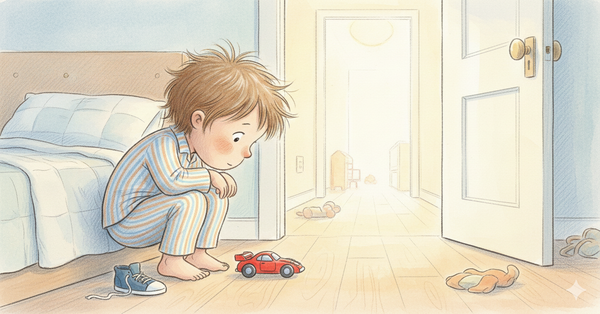
If your mornings look like this — shoes missing, breakfast untouched, backpack still open, and you've said "let's go" six times already — I want you to know something important.
Your child is not being difficult. Their brain is working incredibly hard.
What looks like chaos from the outside is actually a complex neurological performance happening in real time. And once you understand what's running beneath the surface, the morning stops feeling like a battle and starts making a lot more sense.
The Hidden Work Behind "Just Get Ready"
Think about what you're actually asking when you say "time to get ready for school."
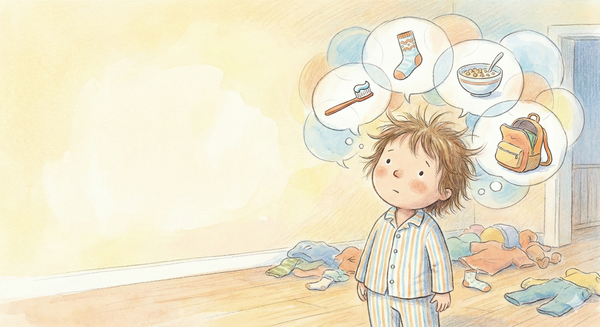
Your child has to wake up and override the pull of sleep. Decide what to do first. Hold a sequence of steps in mind while executing each one. Manage the frustration of a tag that feels scratchy or a sock that won't sit right. Stay on task when something more interesting catches their eye. Track time without really understanding it yet. And do all of this under the low-grade pressure of a clock that means nothing to them but everything to you.
That's not a simple request. That's a neurological marathon before 8 a.m.
The Brain’s CEO
All of that invisible work is driven by a set of mental skills called executive functions — the brain's management system. They handle planning, starting tasks, staying focused, controlling impulses, managing emotions, and shifting gears when things go sideways.
Executive functions live in the prefrontal cortex — the front part of the brain. And here's the part that changes everything for parents: it's the last part of the brain to fully mature. We're talking mid-20s.
This isn't an excuse. It's an explanation.
A six-year-old who can't stay on task isn't lazy. A ten-year-old who melts down when the routine changes isn't manipulative. Their prefrontal cortex is still under construction — and some kids, particularly those with ADHD, are working with a system that develops even more slowly than their peers.
Why This Matters for Your Morning
When mornings fall apart, it's almost never about attitude. It's almost always about which executive skill hit its limit first.
Maybe it's working memory — they forgot what came after brushing teeth the moment they walked out of the bathroom.
Maybe it's task initiation — they genuinely cannot get themselves started without an external push, no matter how many times you've reminded them.
Maybe it's emotional regulation — one small thing went wrong and the whole morning unraveled because they don't yet have the internal tools to reset.
Understanding which skill is struggling changes how you respond. Instead of "why won't you just listen," you start asking "what does this kid need to bridge the gap their brain can't bridge yet?"
Every Small Win Is Brain Training
Here's what I find genuinely encouraging about this, both as a pediatrician and as someone who thinks about child development a lot: executive function skills grow. They're not fixed. Every consistent routine, every morning that ends with shoes on and backpack zipped — even if it took twenty minutes longer than it should have — is real neurological practice.
The brain is learning. It just needs repetition, structure, and a lot of patience to get there.
So the next time your morning feels like you're failing, reframe it: you're actually doing the slow, unglamorous work of building your child's brain. That counts for more than a smooth morning ever could.
What’s Next
In the next post, we’ll break down the 11 core executive skills — attention, working memory, organization, and more — and see how each one shapes a calmer, more independent morning.
Dr. Ali Naqvi is a General Pediatrician and the creator of Morning Momentum — a routine app designed for kids with ADHD and executive function challenges. Momentum Lab is where he writes about the science behind the struggle, and what actually helps.